Yesterday I was in a drugstore and saw the UP MOVE monitors on sale. I am blessed to live in Germany, a highly developed country, so, may be, it's totally normal to encounter physical activity trackers sold in a suburban (no offence, Dachau) shop. May be, this is exactly where they belong to: to essential goods, next to band-aids and aspirin pills. And ayurvedic body oils, of course.
I am a strong believer in quantified self, and I agree with everyone on that knowledge is power: the better you know yourself, the wiser you act. Also, I am a believer in actimetric devices, not because I am engaged with them professionally, but the other way around. Actigraphs are simple in their underlying idea, yet they provide very concise inference. They are absolutely great when you want to find out something related to move and sleep. Just, you know, because when you move you move, and when you sleep you don't move. This is roughly the idea. And as these devices are also very precise, and nowadays they are wrapped in all kind of handy and beautiful interfaces, I like them a lot. So, when I see portable actigraphs on sale in a drugstore, I conclude that people rely on them more and more with every day, and it makes me glad.
I wish Jawbone would let me dig my nose into their data, because their database must be huge, and I am sure I could infer many pretty things on their basis.
Nowadays, activity trackers come in al shapes in forms: from clips to smart watches. What is common for all of them is that they contain an accelerometer that allows to capture the tiniest motions of the body. These gadgets not only help track physical activity but also provide inference about sleep.
Actimetric devices have been vastly implemented for different scopes of medical research. As being portable and relatively cheap, they are handy to measure anything that has to do with motions, and therefore, they are incredibly convenient for research of physical activity and sleep-related matters.
It is intuitively clear and backed by scientific evidence that poor sleep, short sleep, stress (and constipation) affect how we feel and, therefore, perform. We might think that we know ourselves well enough to estimate our sleep, but unfortunately our perceptions do not match the reality.
This is exactly one of those cases when "machine knows better", and we are lucky that, in our modern world, we have reliable, portable and attainable tools such as actimetric monitors to quantify ourselves.
Actigraphs have been validated against polysomnographs (PSG) which, in their turn, are recognised as the gold standard for sleep analysis. In young adult populations, actimetric devices predict sleep bouts correctly in whopping 96% of cases, they predict wake bouts correctly in 36% of cases, and are overall accurate in 86% of cases.
While accelerometers have been known to the world for over a century - take a look at the Google Ngram chart below (this interactive graph shows first occurence and prevalence of listed terms in the body of worlds books tracked by Google) - the use of actigraphic devices to measure sleep has more recent history: the oldest entry that I have discovered in PubMed dates back to 1988 (I was 3 then).
I am a strong believer in quantified self, and I agree with everyone on that knowledge is power: the better you know yourself, the wiser you act. Also, I am a believer in actimetric devices, not because I am engaged with them professionally, but the other way around. Actigraphs are simple in their underlying idea, yet they provide very concise inference. They are absolutely great when you want to find out something related to move and sleep. Just, you know, because when you move you move, and when you sleep you don't move. This is roughly the idea. And as these devices are also very precise, and nowadays they are wrapped in all kind of handy and beautiful interfaces, I like them a lot. So, when I see portable actigraphs on sale in a drugstore, I conclude that people rely on them more and more with every day, and it makes me glad.
I wish Jawbone would let me dig my nose into their data, because their database must be huge, and I am sure I could infer many pretty things on their basis.
Nowadays, activity trackers come in al shapes in forms: from clips to smart watches. What is common for all of them is that they contain an accelerometer that allows to capture the tiniest motions of the body. These gadgets not only help track physical activity but also provide inference about sleep.
Actimetric devices have been vastly implemented for different scopes of medical research. As being portable and relatively cheap, they are handy to measure anything that has to do with motions, and therefore, they are incredibly convenient for research of physical activity and sleep-related matters.
It is intuitively clear and backed by scientific evidence that poor sleep, short sleep, stress (and constipation) affect how we feel and, therefore, perform. We might think that we know ourselves well enough to estimate our sleep, but unfortunately our perceptions do not match the reality.
This is exactly one of those cases when "machine knows better", and we are lucky that, in our modern world, we have reliable, portable and attainable tools such as actimetric monitors to quantify ourselves.
Actigraphs have been validated against polysomnographs (PSG) which, in their turn, are recognised as the gold standard for sleep analysis. In young adult populations, actimetric devices predict sleep bouts correctly in whopping 96% of cases, they predict wake bouts correctly in 36% of cases, and are overall accurate in 86% of cases.
While accelerometers have been known to the world for over a century - take a look at the Google Ngram chart below (this interactive graph shows first occurence and prevalence of listed terms in the body of worlds books tracked by Google) - the use of actigraphic devices to measure sleep has more recent history: the oldest entry that I have discovered in PubMed dates back to 1988 (I was 3 then).
link to the Ngram (to open in a new tab)
The rationale behind the use of actigraphy for sleep analysis are plain and simple. Below is a brief explanation on how sleep can be actually assessed by these devices.
An accelerometer is a tool that captures accelerations of an object (or a subject, for that matter) across three othogonal motion planes: vertical, horizontal and depth. In a tracking device, accelerations are captured at every epoch (i.e., time unit) which is commonly set to one second.
There are several ways how an actigraph stores the activity data for each time period. One of them is the Proportional Integral Mode (PIM). It computes the area under curve over the three axes, yielding the so-called composite activity counts.
There are specific algorthims that analyse activity counts at ever moment during a certain period (think one night), and they allot this period between two buckets: sleep state and wake state. Two of the most common methods are: the Sadeh algorithm, which is mostly used for adolescent populations, and the Cole-Kripke algorithm, which is typically employed for adults. Both of the algorithms are validated and provide similar results, where the Sadeh method has a somewhat higher sensitivity and specificity.
And then the accounting happens. All added up, the sleep bouts form the sleep duration. Also, depending on its interface, the program associated with the actimetric device can report many other things like sleep latency (the time in which you fall asleep), wake after sleep onset (the total time you have been awake after the commencement of sleep) and sleep efficiency.
The last one somewhat ambiguous because it can either denote the ratio between your total sleep time and the time you were in bed, or, alternatively, it can compare your total sleep time to some benchmark time. For example, if you have a commercial sleep tracker and you set a goal of sleeping 8 hours every night, the numbers on your screen will reflect the percentage your sleep time makes of this goal.
My advice: don't do that. If you struggle to sleep these 8 hours for any reason - a sleep disorder, a demanding office job, a baby, - your constant "underperformance in sleep" will only stress you out. As a result, you will be all worked up and sleep worse. True story.
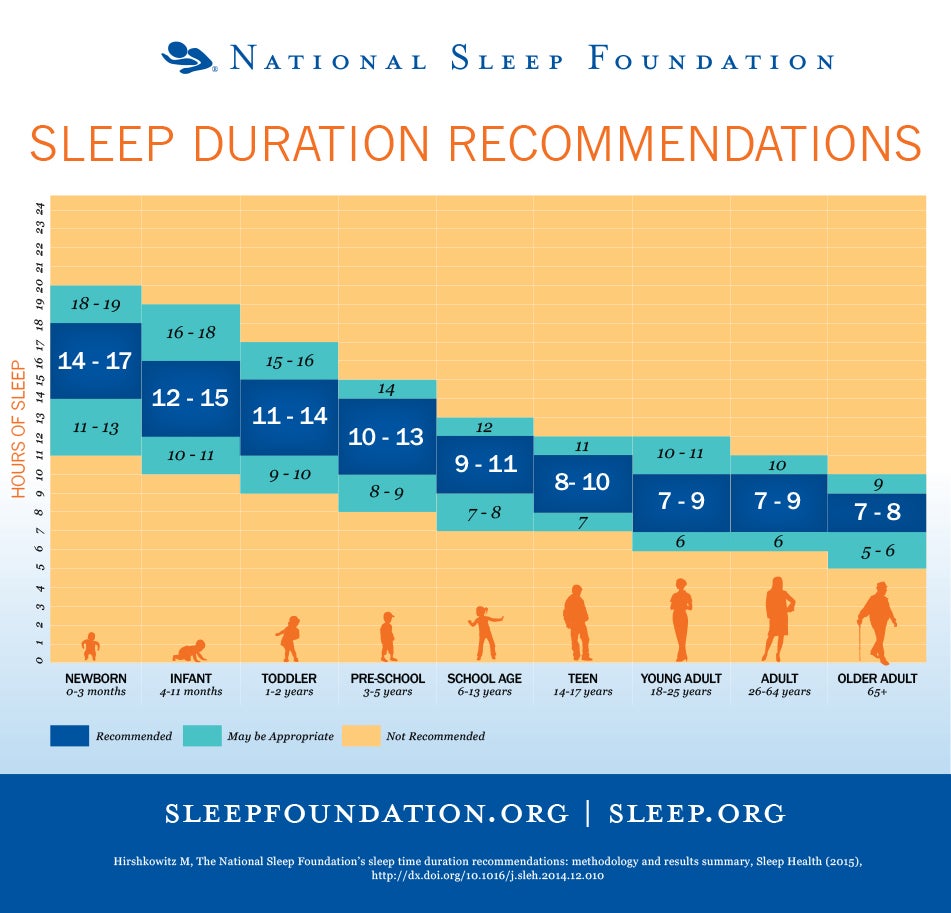
How much sleep you really need is a complicated matter which could be discussed in detail, but it is nicely wrapped up in this chart.

No hay comentarios:
Publicar un comentario