One person told me recently: "You should to watch more TV!" I literally laughed out loud.
Until I remembered the following. "The Monty Hall Problem", a cornerstone probabilistic problem that is explained as part of both foundation and advanced courses at leading universities, originates nowhere but on the blue TV screen!
Monty Hall (born 1921) is a Canadian TV presenter who hosted the popular TV show "Let's Make a Deal!" for many years. Not only has this show given many Americans an opportunity to bring some valuable stuff or, well, zonks ("useless stuff" - Lyolya) to their homes

but also it has driven the appearance of a widely discussed mathematical problem in the "American Statistician" magazine in 1975 (thanks to Dr. Steve Selvin).
I personally have been exposed to this problem three times: as a part of my grad course on theory of probability, as a part of my master's course (I believe the subject was called "something something strategies" and they also explained us "The Prisoner's Dillema" and Nash equilibrium stuff within the bounds of this course) and most recently - as a part of my preparations to job interviews.
Apparently, the Monty Hall problem and its derivations are a beloved question of interviewers to quantitative positions in the English-speaking world. Dr. Timothy Falcon Crack has written a very famous book which explains several versions of it.
Briefly, if you haven't followed the link to Amer. Statist., the problem sounds as follows. Monty Hall hosts a show, and you are a participant to it. There are three doors in front of you. You know that there is a prize behind one door, and nothing behind the other two (or, zonks, in "Let's Make a Deal!" terms). You pick a door. Then Monty Hall tells you that he can open another door for you which he knows is empty. After that being done, he will give you a chance to change your mind and pick another door, the one that he has not open yet. The question is: should you rather take the chance and switch or stick to your initial choice?
The correct response is that you should switch, and the fact that this is a counterintuitive decision makes The Monty Hall Problem so famous. Two solutions to this problem are presented in Dr. Crack's book: one of them is simple deduction, and the other one is formal and involves the Bayes' theorem. The solutions can be found elsewhere. The key to the intuitive solution is that you should figure out the the probability that your initial pick is an empty door. Also, there is a graphical solution that I have found online and that I like a lot:

You might wonder, if there is a derivation to this problem where switching does now yield better odds of winning. Well, there is. In Dr. Crack book, a derivation is proposed when an empty door is revealed to you not by Monty Hall but a random someone from the audience. So, in this case, if they, as Monty Hall, have prior knowledge on distribution behind the doors, you should switch, too. However, when they randomly open a door and it turns out to be empty by chance, you have the probability of 50 percent of winning by switching, and the same probability of winning by not doing so. So, you are indifferent. Therefore, the the most important thing here is whether the person who opens the door knows how the prizes are distributed or not.
This is an all Bayesian problem. :-)
The Monty Hall problem reminds me a lot of a book that I used to love a s a child. Raymond Smullyan's "The Lady or the Tiger" contains a whole set of logical puzzles of a similar kind, together with other interesting brainteasers. However, I remember that when I was ten, "the-princess-or-the-tiger" part of the book (the one that actually narrates the stories of prisoners thrown into a quest of life-or-death) seemed totally engrossing to me.
The Smullyan's approach to the Monty Hall show is not probabilistic rather than logical. You have a set of trials (hello, clinical researchers!), each subsequent harder than the previous one, in each of which a prisoner has to pick a door. The door can either have a princess behind it (it is noteworthy to mention that this is a lucky outcome), a tiger, and, in some trials, an empty room. Moreover, there are shields to these doors that inform about what is behind them. They either tell the truth or not - depending on what/who is inside. Sometimes, they can even not be attached to the doors at all! Anyway, you can get away with the information you have each time, and at each trial save your life, happily resolving the puzzle and marrying a princess. If you were the ninth prisoner, your fate would look like that:

I have encountered this picture on the internets, if you wonder what some other trials look like, try the Amazon sample of the book.
Doors is quite a popular topic for brainteasers, and you can find various problems in books, folklore and the internets - like this one, for instance. Doors can be seen as an allegory for real-life decision processes, and the difference between stochastic and logical approaches to the doors problem is that the first handles situations of total randomness, while the other one is deterministic, indicating that there is a "correct" solution, and you only have to be smart enough to find it. I believe that people, when not knowing in which situation they are, prefer to believe that they are the deterministic one. When no unambiguous indicators are given, people tend to look for "sings". And I probably do so myself, too, despite that I have been specifically trained to estimate the odds of any outcome. We are all optimists.
Until I remembered the following. "The Monty Hall Problem", a cornerstone probabilistic problem that is explained as part of both foundation and advanced courses at leading universities, originates nowhere but on the blue TV screen!
Monty Hall (born 1921) is a Canadian TV presenter who hosted the popular TV show "Let's Make a Deal!" for many years. Not only has this show given many Americans an opportunity to bring some valuable stuff or, well, zonks ("useless stuff" - Lyolya) to their homes

image source: http://gameshows.about.com/od/photogalleries/ig/Let-s-Make-a-Deal-2009/LMAD-Zonk-Model-Large.htm
but also it has driven the appearance of a widely discussed mathematical problem in the "American Statistician" magazine in 1975 (thanks to Dr. Steve Selvin).
I personally have been exposed to this problem three times: as a part of my grad course on theory of probability, as a part of my master's course (I believe the subject was called "something something strategies" and they also explained us "The Prisoner's Dillema" and Nash equilibrium stuff within the bounds of this course) and most recently - as a part of my preparations to job interviews.
Apparently, the Monty Hall problem and its derivations are a beloved question of interviewers to quantitative positions in the English-speaking world. Dr. Timothy Falcon Crack has written a very famous book which explains several versions of it.
Briefly, if you haven't followed the link to Amer. Statist., the problem sounds as follows. Monty Hall hosts a show, and you are a participant to it. There are three doors in front of you. You know that there is a prize behind one door, and nothing behind the other two (or, zonks, in "Let's Make a Deal!" terms). You pick a door. Then Monty Hall tells you that he can open another door for you which he knows is empty. After that being done, he will give you a chance to change your mind and pick another door, the one that he has not open yet. The question is: should you rather take the chance and switch or stick to your initial choice?
The correct response is that you should switch, and the fact that this is a counterintuitive decision makes The Monty Hall Problem so famous. Two solutions to this problem are presented in Dr. Crack's book: one of them is simple deduction, and the other one is formal and involves the Bayes' theorem. The solutions can be found elsewhere. The key to the intuitive solution is that you should figure out the the probability that your initial pick is an empty door. Also, there is a graphical solution that I have found online and that I like a lot:
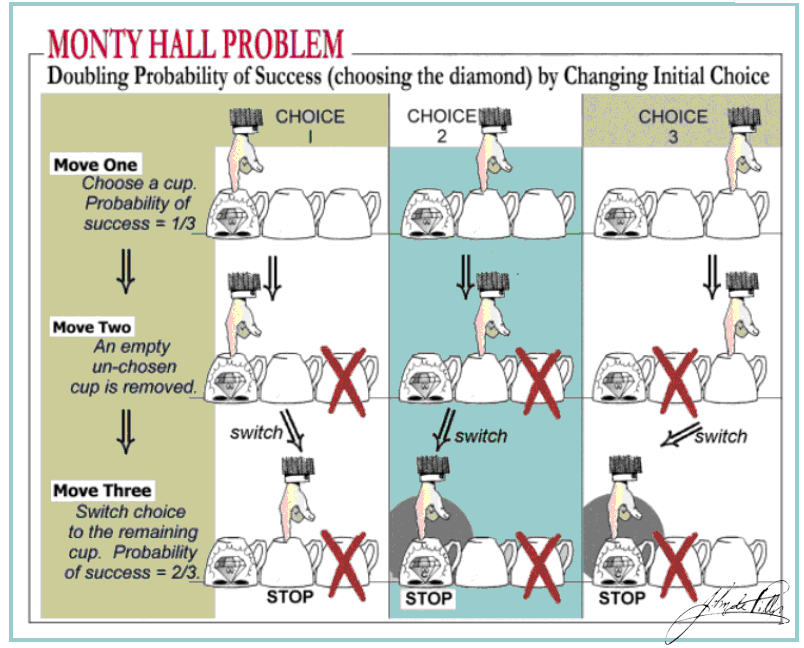
image source: http://math.ucr.edu/~jdp/Monty_Hall/Monty_Hall.html
You might wonder, if there is a derivation to this problem where switching does now yield better odds of winning. Well, there is. In Dr. Crack book, a derivation is proposed when an empty door is revealed to you not by Monty Hall but a random someone from the audience. So, in this case, if they, as Monty Hall, have prior knowledge on distribution behind the doors, you should switch, too. However, when they randomly open a door and it turns out to be empty by chance, you have the probability of 50 percent of winning by switching, and the same probability of winning by not doing so. So, you are indifferent. Therefore, the the most important thing here is whether the person who opens the door knows how the prizes are distributed or not.
This is an all Bayesian problem. :-)
The Monty Hall problem reminds me a lot of a book that I used to love a s a child. Raymond Smullyan's "The Lady or the Tiger" contains a whole set of logical puzzles of a similar kind, together with other interesting brainteasers. However, I remember that when I was ten, "the-princess-or-the-tiger" part of the book (the one that actually narrates the stories of prisoners thrown into a quest of life-or-death) seemed totally engrossing to me.
The Smullyan's approach to the Monty Hall show is not probabilistic rather than logical. You have a set of trials (hello, clinical researchers!), each subsequent harder than the previous one, in each of which a prisoner has to pick a door. The door can either have a princess behind it (it is noteworthy to mention that this is a lucky outcome), a tiger, and, in some trials, an empty room. Moreover, there are shields to these doors that inform about what is behind them. They either tell the truth or not - depending on what/who is inside. Sometimes, they can even not be attached to the doors at all! Anyway, you can get away with the information you have each time, and at each trial save your life, happily resolving the puzzle and marrying a princess. If you were the ninth prisoner, your fate would look like that:
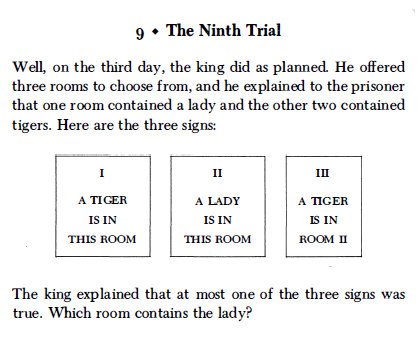
I have encountered this picture on the internets, if you wonder what some other trials look like, try the Amazon sample of the book.
Doors is quite a popular topic for brainteasers, and you can find various problems in books, folklore and the internets - like this one, for instance. Doors can be seen as an allegory for real-life decision processes, and the difference between stochastic and logical approaches to the doors problem is that the first handles situations of total randomness, while the other one is deterministic, indicating that there is a "correct" solution, and you only have to be smart enough to find it. I believe that people, when not knowing in which situation they are, prefer to believe that they are the deterministic one. When no unambiguous indicators are given, people tend to look for "sings". And I probably do so myself, too, despite that I have been specifically trained to estimate the odds of any outcome. We are all optimists.

No hay comentarios:
Publicar un comentario